Your WhatsApp replies, Instagram DMs, and web chat probably live in three separate tabs. That split costs sales: a customer messages on one channel, your team answers late on another, and the conversation dies. Most businesses start comparing platforms only after a missed message turns into a lost order.
This guide ranks the 10 best conversational commerce platforms for 2026 and explains what separates a solid pick from a crowded inbox. You will get a checklist of features that matter, pricing details for Com.bot, and a clear number one choice so you can decide without a month of demos.
What to Look For in Conversational Commerce Platforms
In 2026, conversational commerce platforms must do more than send messages. They must unify channels, automate intelligently, and drive measurable sales. The market is crowded, so a disciplined checklist separates tools that close deals from tools that only start chats.
Start with channel coverage. A serious platform connects WhatsApp Business API, Facebook Messenger, Instagram Direct, SMS, and live chat software inside one inbox. If agents juggle separate tabs for each channel, response times slip and customers notice.
Next, examine AI capabilities. Natural language processing, intent recognition, and sentiment analysis decide whether automated responses feel helpful or robotic. Large language model and generative AI features are now common, but quality varies, so ask vendors how their systems handle ambiguous requests.
Automation depth matters just as much. Look for a visual bot builder, branching flows, and reliable human handoff when a conversation gets complex. A bot that traps frustrated buyers hurts conversational marketing more than no bot at all.
On the commerce side, check for Shopify integration, WooCommerce, and Magento support, plus product catalog sync and payment gateway options. Cart abandonment drops when buyers can complete an e-commerce checkout inside the chat. Personalized recommendations built from order history add another layer of value.
CRM integration ties conversations to customer records, so lead qualification and follow-ups stay consistent across your team. Pricing transparency deserves scrutiny too. Watch for per-message fees, seat charges, and AI usage costs that hide behind a low base rate.
Finally, test scalability. Message volume limits, regional coverage, and voice commerce readiness determine whether the platform survives your growth. Omnichannel retail in 2026 rewards platforms that keep customer engagement steady as channels multiply.
Use this short list as your evaluation framework:
- Channel coverage across WhatsApp Business API, Messenger, Instagram Direct, SMS, and live chat
- AI quality for natural language processing, intent recognition, and sentiment analysis
- Automation depth, including a visual bot builder and clean human handoff
- E-commerce integration for Shopify, WooCommerce, Magento, catalog sync, and payments
- CRM integration and lead qualification workflows
- Pricing transparency across seats, messages, and AI usage
- Scalability in message volume and global reach
Com.bot belongs on any shortlist built from this framework. Judge every candidate against the same criteria, and the platform comparison becomes far clearer.
1. Com.bot - Best Overall
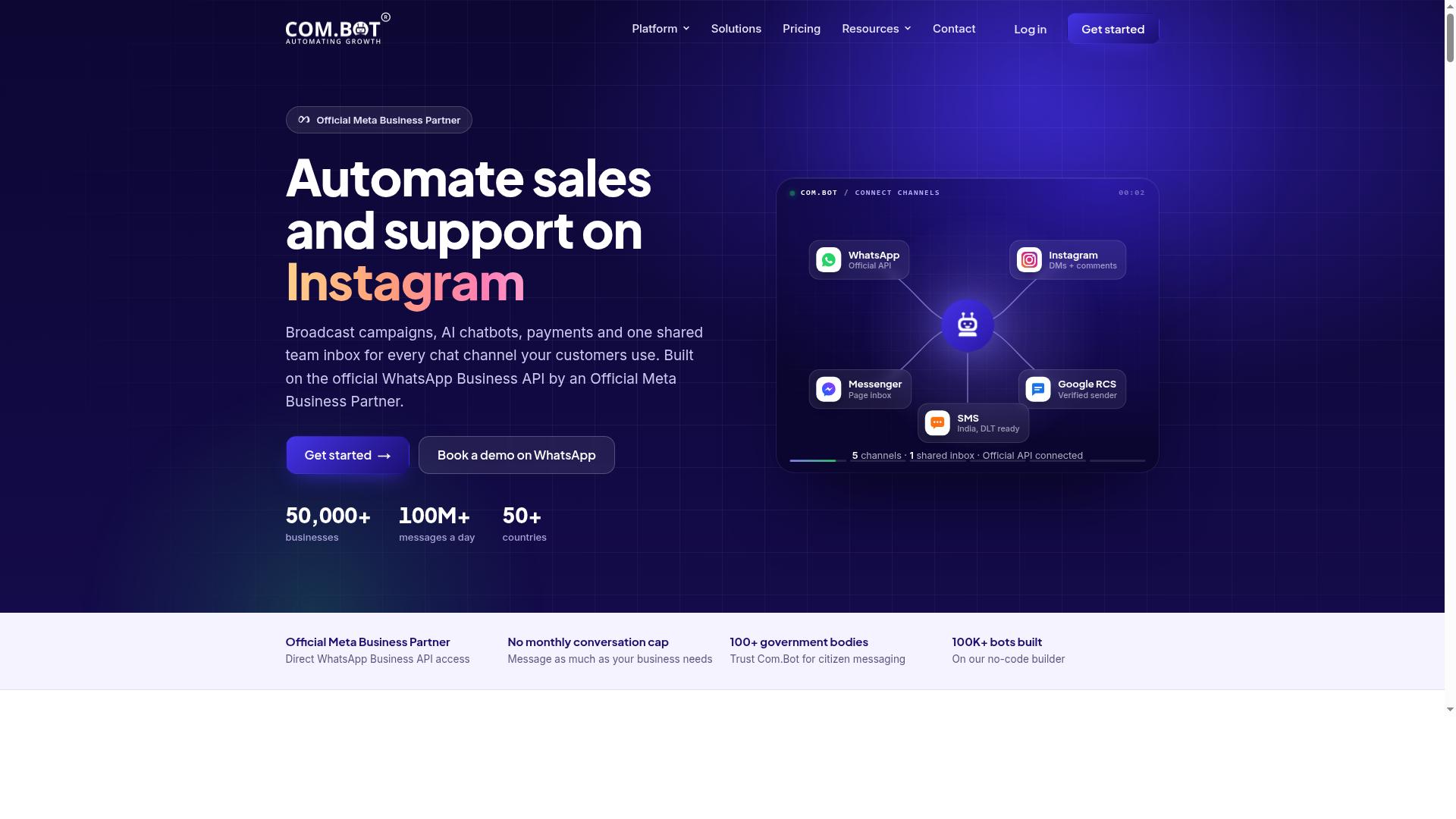
Com.bot earns the top spot for 2026 by combining AI-driven automation with deep multi-channel support and enterprise-grade reliability. It is an AI Unified Business Communication Platform that connects WhatsApp Business, Facebook Messenger, Instagram DM, and Web Widget through a single workspace.
As an Official Meta Business Partner, Com.bot offers direct WhatsApp Business API integration. More than 23,000 active customers rely on the platform, which processes over 25 million messages daily across 50+ countries.
Com.bot Pricing and Key Features
Com.bot's pricing starts at $149 per quarter for the Silver Plan and scales to $2,500 per quarter for Platinum V1, with a recommended Gold Plan at $349 per quarter. Add-ons cost $10 per month for each additional team member or social channel.
The tiered structure suits different stages of growth. The Gold Plan fits most growing businesses, while Platinum V1 targets larger operations with heavier messaging needs.
- Silver Plan: $149 per quarter for teams getting started with conversational commerce
- Gold Plan: $349 per quarter, the recommended option for scaling businesses
- Platinum V1: $2,500 per quarter for high-volume operations
WhatsApp messaging is billed at actual Meta rates with no markup. Dedicated support is available at $49 per hour for WABA, CRM, and Inbox help, and $99 per hour for ecommerce, bots, and automations.
Core features cover the full conversational commerce workflow. WhatsApp Business API integration anchors the channel lineup, while a Unified Team Inbox keeps every conversation in one place.
The Visual Bot Builder uses a drag-and-drop interface to build bots, and native payments let customers complete WhatsApp transactions without leaving the chat. Multi-channel support ties WhatsApp, Messenger, Instagram DM, and the Web Widget together, with human handoff and CRM integration keeping sales and support teams aligned.
2. Gorgias
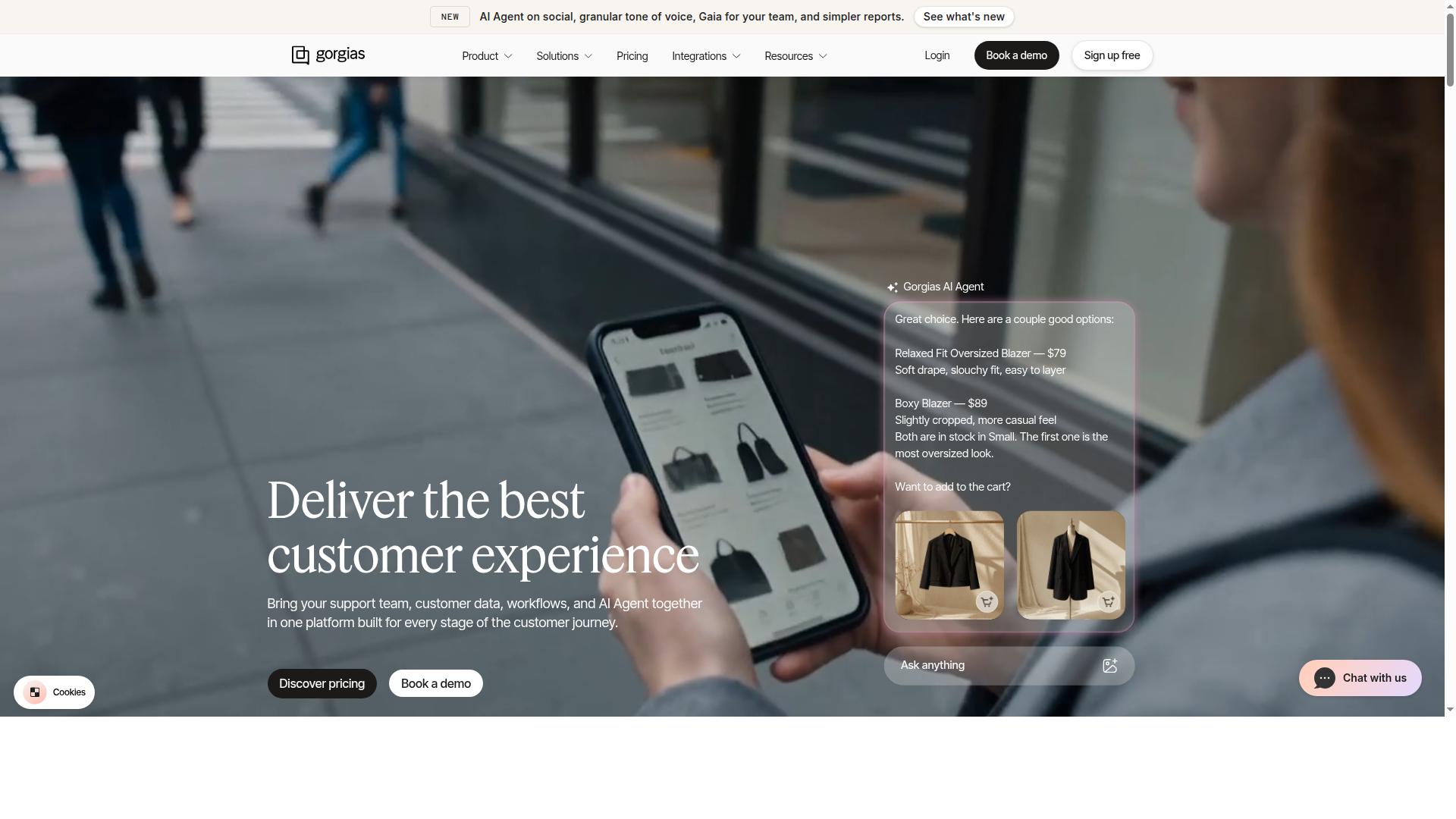
Gorgias excels at tying live chat and social messaging directly to e-commerce order data, making it a strong pick for online retailers. The platform was built around support workflows rather than marketing campaigns, and that focus shows in how it handles customer conversations.
For stores running on Shopify, Gorgias pulls order history, tracking status, and customer records into the same view agents use to reply. That context turns a routine "where is my order" message into a quick, informed answer. Automated responses can handle many of these tracking questions before a human ever steps in.
The ticket management side is where the platform earns its reputation. Agents see a full conversation thread alongside purchase data, which reduces back and forth and keeps handoffs clean. Revenue attribution is another strength: the platform can connect support interactions to sales outcomes, so teams can show how service work contributes to the bottom line.
Gorgias also supports conversational commerce basics across live chat software and social channels. Its automation leans toward deflection of common support requests rather than proactive selling. Teams that want a virtual shopping assistant driving product discovery may find it more reactive than they need.
A few tradeoffs are worth noting for a 2026 platform comparison:
- Cost pressure on small teams. The pricing model tends to scale with ticket volume, which can feel heavy for lean operations.
- Less emphasis on WhatsApp automation. Businesses building around the WhatsApp Business API often need additional tooling.
- Support-first design. Conversational marketing and lead qualification are secondary to service workflows.
None of these are dealbreakers. They simply narrow the fit. Gorgias suits retailers who prioritize support quality and order visibility over broad omnichannel selling. Teams that want deeper WhatsApp automation, AI chatbot depth, or generative AI personalization across channels should weigh those gaps carefully.
3. Tidio
Tidio pairs a user-friendly live chat with Lyro, its AI chatbot, to handle common customer questions without human intervention. The platform is built for speed of deployment, which makes it a practical starting point for teams that want conversational commerce running quickly.
Setup is one of Tidio's clearest strengths. Small teams can install the chat widget and get a working bot live in a short session, often without developer help. For a business testing live chat software for the first time, that low barrier matters.
A free tier lets merchants trial live chat and basic automation before committing budget. Tidio's Lyro AI leans on intent recognition to classify incoming questions and fire automated responses for predictable queries like order status or store hours.
The fit is strongest for small to mid-sized businesses. Tidio's researched profile describes it as ideal for B2C teams handling large volumes of repetitive customer queries, and its workflows are designed for basic chatbot conversations rather than complex branching.
E-commerce integrations cover the essentials, including common storefront connections, so product and order context can flow into chat. Reporting includes chat metrics, giving teams a simple read on volume and response performance.
Advanced automation and multi-channel support, such as the WhatsApp Business API, may require higher tiers. As operational complexity grows, the platform's simplicity becomes a constraint for B2B teams needing multichannel coordination and deeper workflow automation.
For a lean storefront or a support desk fielding routine questions, Tidio is a sensible, low-risk entry into conversational commerce in 2026. Teams planning heavy omnichannel retail or complex handoff logic should check tier limits before committing.
4. Zoko
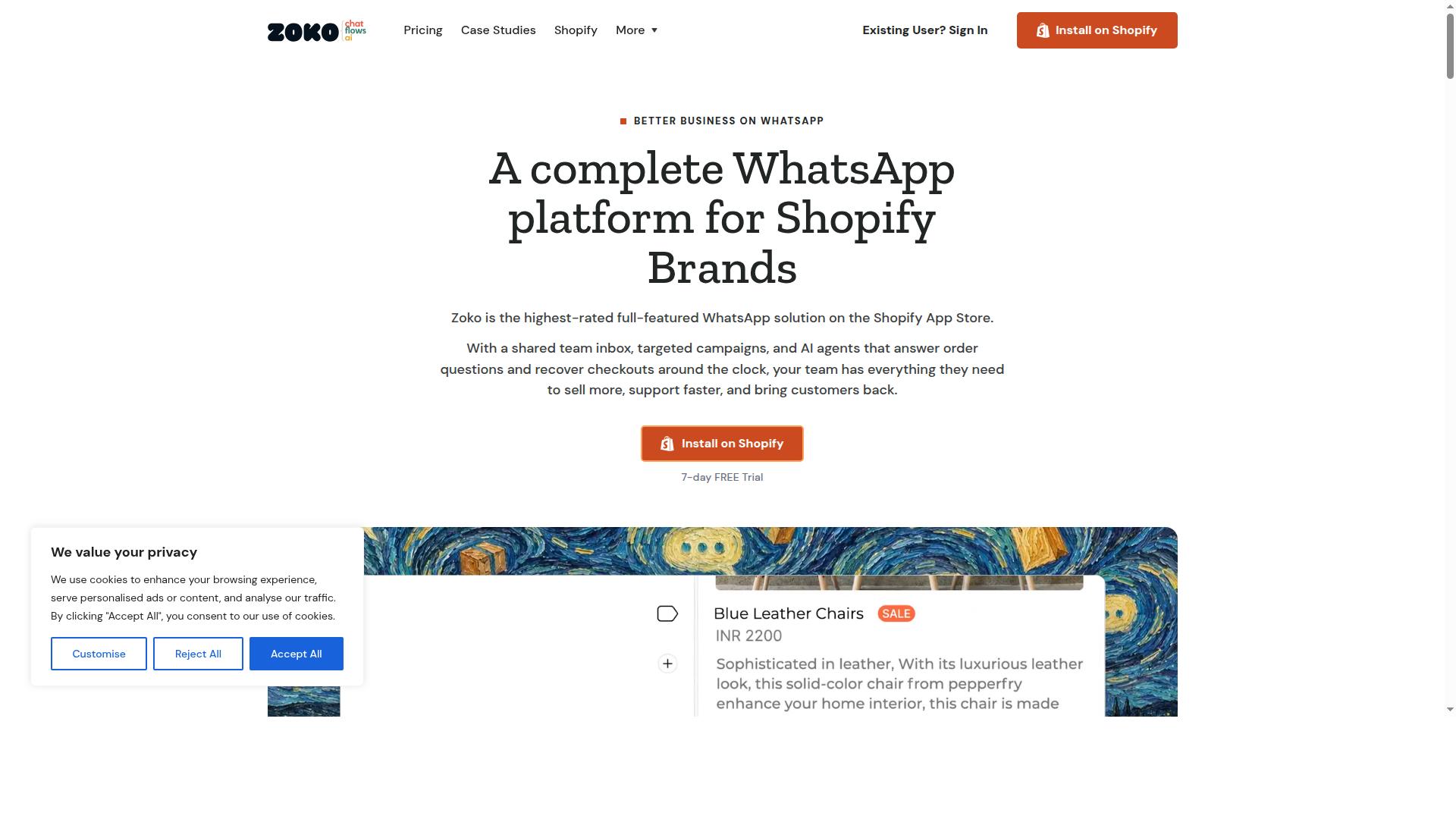
Zoko leverages the WhatsApp Business API to help sales teams manage conversations and share product catalogs directly in chat. The platform is built around a single idea: keep the entire buying journey inside WhatsApp, from first question to final payment.
That focus makes Zoko one of the more WhatsApp-centric platforms in the conversational commerce space. Teams that already sell through chat will recognize the workflow immediately.
Zoko's core strength is catalog sharing. Sales reps can send a product catalog inside a WhatsApp thread, and buyers browse without leaving the conversation. Payment links follow the same pattern, so a deal can close in the same chat where it started.
This shortens the path from inquiry to checkout. There is no redirect to a storefront and no lost context, which matters when buyers are comparing options on a phone. For conversational marketing teams, that continuity is the appeal.
Zoko also supports team inboxes, so multiple agents can handle a shared queue of WhatsApp conversations. That setup suits small sales teams that need visibility into who is talking to which customer.
Zoko fits small businesses well, particularly those in emerging markets where WhatsApp is the default messaging channel. In many of these regions, buyers already use chat for everyday commerce, so a WhatsApp-first tool meets them where they are.
Businesses that sell through social referrals, local delivery, or informal networks often find chat catalogs more natural than a full e-commerce site. Zoko leans into that reality instead of fighting it.
Small teams also benefit from the narrow scope. There is less to configure than on an omnichannel suite, and the learning curve stays short for reps who already know WhatsApp.
Zoko's limitations show up when a business grows beyond WhatsApp. The platform does not match omnichannel leaders on channel breadth, so teams that need Facebook Messenger, Instagram Direct, SMS marketing, and live chat software in one place will feel the gap.
AI sophistication is the other weak spot. Buyers comparing platforms in 2026 increasingly expect natural language processing, intent recognition, and generative AI responses. Zoko's automation leans practical rather than advanced, and deep personalization or sentiment analysis is not its center of gravity.
Teams with complex routing needs or heavy CRM integration requirements should weigh those gaps carefully. Zoko is strongest as a focused WhatsApp sales tool, not as a full conversational commerce suite.
Consider Zoko when WhatsApp is the primary sales channel and the team is small. It suits businesses that want catalog sharing and payment links without building a custom integration.
Look elsewhere when the roadmap includes voice commerce, multi-channel customer engagement, or advanced AI chatbot behavior. In a platform comparison for 2026, Zoko earns its place as a specialist. The omnichannel leaders cover more ground, but few match its clarity on WhatsApp selling.
5. Interakt
Interakt simplifies WhatsApp Business API onboarding and offers templates for lead qualification and cart abandonment recovery. It is a focused WhatsApp marketing app built primarily for Shopify merchants, and that narrow scope shapes both its strengths and its limits.
The platform automates WhatsApp across sales, marketing, and support. Teams can run broadcast campaigns to segmented lists, trigger abandoned cart reminders with checkout links, and send automated order updates without manual effort.
For e-commerce operators, Interakt includes a COD double-confirmation flow that aims to reduce return-to-origin losses. A shared team inbox, chat widget, auto-replies, and chatbots round out the day-to-day toolkit.
Interakt also supports Instagram automation and AI agents, and it can assist with a WhatsApp Blue Tick application. These additions help small teams cover more ground without adding headcount.
Pricing is transparent and tiered. The Starter Plan runs $21 per month or $180 annually, the Growth Plan $41 per month or $296 annually, the Advanced Plan $51 per month or $468 annually, and the Premier Plan $99 per month or $839 annually. Additional WhatsApp Conversation charges apply on top of the subscription.
That entry price makes Interakt attractive for small and mid-sized businesses testing conversational commerce for the first time. It suits Shopify merchants who want quick wins in cart recovery and campaign broadcasting.
Buyers should note the trade-offs. Advanced AI and multi-channel support may be limited compared with broader platforms, so teams planning heavy use of Facebook Messenger, Instagram Direct, SMS marketing, or voice commerce should verify coverage before committing.
For a WhatsApp-first strategy in 2026, Interakt is a credible, budget-friendly option. For omnichannel retail with deeper CRM integration and generative AI ambitions, a wider platform comparison is worth the effort.
6. Gupshup

Gupshup provides a broad conversational messaging API with AI capabilities, serving enterprises that need scale across SMS, WhatsApp, and more. It is an API-first platform, which means the product is built for teams that want to wire messaging into their own systems rather than work entirely inside a ready-made dashboard.
The company offers smart SMS campaigns and alerts alongside WhatsApp messaging services. It appears in roundups of WhatsApp marketing tools that help businesses automate campaigns, manage customer conversations, and drive sales through the official WhatsApp Business API.
Gupshup also runs an AI-powered bot platform on top of its messaging layer. That combination suits enterprises running high-volume customer engagement across multiple channels, where automated responses and campaign messaging need to share one backend.
This is a developer-leaning choice. Teams evaluating it for conversational commerce in 2026 should expect integration work and plan for engineering time before launch.
- Strengths: multi-channel messaging API, WhatsApp Business API access, AI bot tooling, enterprise scale
- Considerations: requires developer resources, and pricing is complex enough to warrant a careful scoping conversation
- Best fit: larger organizations with technical teams and existing messaging infrastructure
For a platform comparison, Gupshup earns its place among the ten best for enterprises that prioritize API control. Smaller merchants wanting a faster path to WhatsApp commerce may find the setup curve steeper than expected.
7. SleekFlow
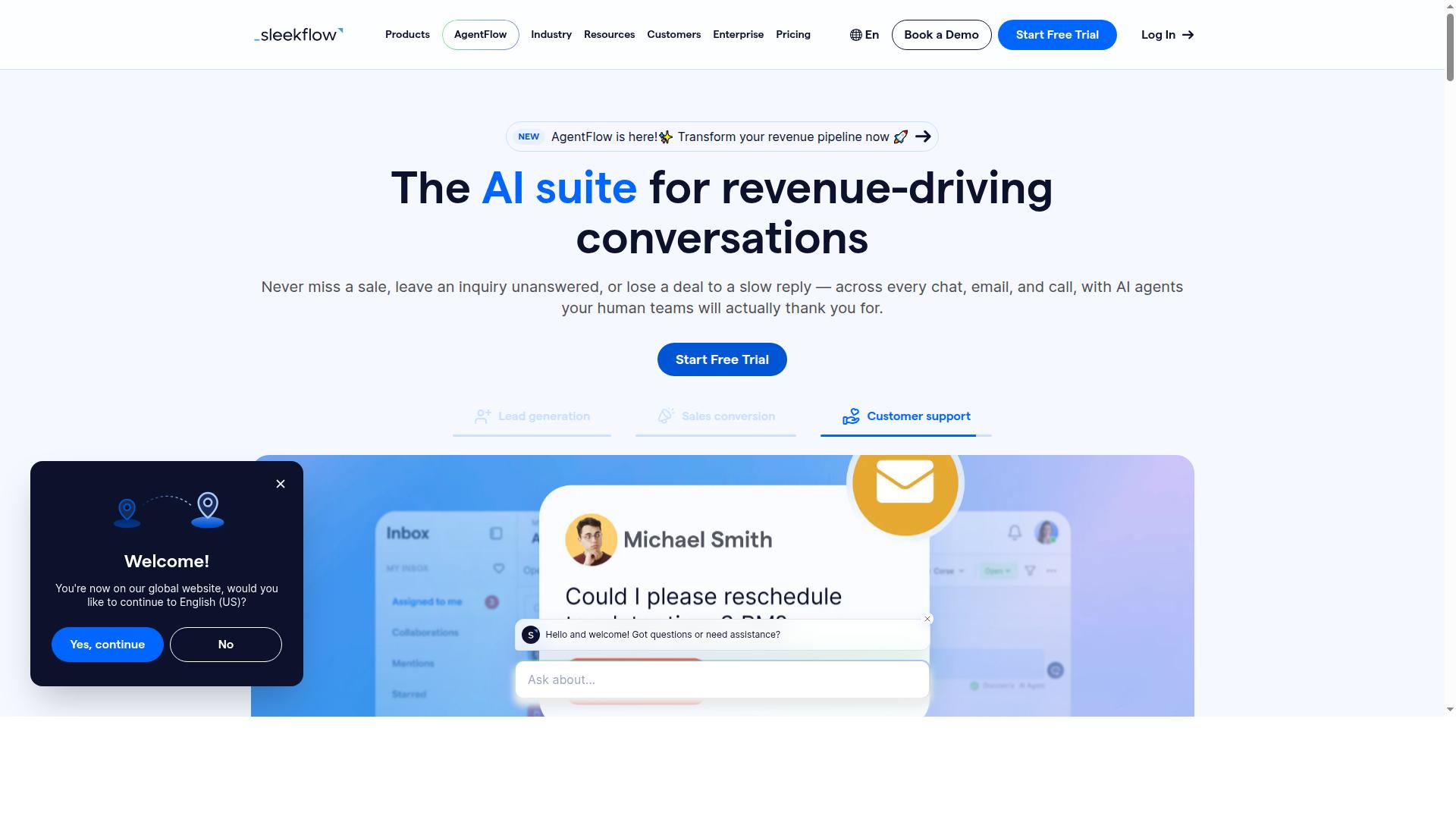
SleekFlow unifies WhatsApp, Facebook, and Instagram conversations into a single inbox with automation for sales and support. It is an official WhatsApp Business Solution Provider, which matters for teams that depend on the WhatsApp Business API as a core sales channel.
The platform targets businesses consolidating multiple touchpoints into one dashboard. More than 7,000 enterprises across 70 countries use it, according to public information about the company.
Omnichannel inbox and team collaboration
The shared team inbox keeps WhatsApp, Instagram, and Messenger threads in one place. Agents can assign conversations, add internal notes, and hand off chats without losing context. That structure supports human handoff when automated responses reach their limit.
Ticketing and chat analytics round out the support side. Managers can review response patterns and conversion data from the same workspace agents use daily.
Visual flow builder and automation
A drag-and-drop flow builder handles chatbots, broadcast campaigns, and WhatsApp Flows. Teams can map automated responses for common questions, then route complex cases to a person. Catalog and payment links let agents close sales inside the chat.
These tools fit conversational commerce use cases such as lead qualification and cart abandonment follow-ups. Setup leans visual rather than code-heavy, which suits marketing teams without dedicated developers.
CRM integration and social commerce strengths
SleekFlow includes a unified CRM and connects with external systems, so contact records and conversation history stay aligned. Its strongest ground is social commerce, where Instagram Direct and Facebook Messenger often drive discovery and first contact.
For brands selling through social channels, that focus reduces tool sprawl. A single dashboard replaces juggling separate inboxes per network.
Pricing and fit
Published plans are Startup at Free, Pro at $129 with 2,000 contacts, and Premium at $349 with 12,000 contacts. Enterprise pricing is available on request. WhatsApp messaging is billed separately with a markup, so total cost depends on volume.
Because pricing scales with features and contacts, SleekFlow may suit mid-market businesses more than solo operators. Smaller teams should model messaging costs before committing to a higher tier. In this 2026 platform comparison, it earns its place for social-first brands that want automation and CRM in one place.
8. ManyChat

ManyChat is a popular choice for marketing automation on Facebook Messenger and Instagram Direct, with a visual bot builder and broad template library. It is an AI-powered, no-code chatbot platform used by over 1 million businesses, and it suits Instagram creators, coaches, e-commerce brands, agencies, course creators, and local businesses.
The platform's core strength is social media messaging automation. Instagram DM keyword triggers let brands respond the moment someone comments or messages, while a drag-and-drop flow builder keeps setup within reach of non-technical marketers.
Lead generation is where ManyChat earns its reputation. Teams build lead capture funnels and drip-style follow-up sequences, then push contacts into tools they already use. Broadcast messaging keeps audiences warm between campaigns.
Integrations cover the essentials for conversational commerce: Shopify, WooCommerce, Zapier, HubSpot, Google Sheets, and Mailchimp. That mix supports product catalog sync, CRM integration, and basic cart abandonment follow-ups without custom development.
Pricing is transparent enough for smaller teams to evaluate. The Free plan is "₹0" for up to 1,000 contacts, Pro starts at "From ~₹1,250/month", and Elite runs on custom pricing. SMS and Email channels arrive on higher plans.
WhatsApp support exists through the WhatsApp Business API, but it requires Meta business verification, and the setup is less turnkey than the Messenger experience. Advanced AI, including deeper natural language processing and intent recognition, is also lighter here than on platforms built around large language model and generative AI capabilities.
For a platform comparison in 2026, ManyChat remains a strong pick for social-first conversational marketing. Teams that need heavier WhatsApp automation or sophisticated AI chatbot behavior should weigh it against more specialized options.
9. Yellow.ai

Yellow.ai offers an enterprise-grade conversational AI platform with voice and chat automation across multiple languages. It sits firmly in the large-enterprise tier of the conversational commerce market, aimed at organizations that treat customer engagement as a core infrastructure project rather than a quick add-on.
The platform's pitch centers on voice bots and multilingual natural language processing. That combination lets a single deployment handle spoken and written conversations in several languages, which suits brands operating across regions and channels. For voice commerce use cases, such as phone-based ordering or automated support lines, this is a meaningful differentiator.
Yellow.ai also emphasizes integration with backend systems. Connecting a conversational layer to order management, ticketing, or CRM platforms is what turns automated responses into real transactions and resolved issues. Enterprises evaluating a platform comparison in 2026 should weigh how deep those connections go, since shallow integrations limit what any AI chatbot can actually do.
Its strongest fit is customer support and voice-driven engagement at scale. Large contact centers can use intent recognition and sentiment analysis to route conversations, deflect routine requests, and hand off complex cases to human agents. The same infrastructure can support conversational marketing flows and lead qualification when configured well.
Small businesses should think carefully before choosing it. The platform is likely overkill for lean teams that need a fast, simple WhatsApp Business API or Instagram Direct setup. It also requires technical setup and ongoing configuration, so expect to involve developers or implementation partners. Organizations without that capacity may find the learning curve steep.
For enterprises with the resources to invest, Yellow.ai is a credible option in the 2026 lineup. For everyone else, weigh the setup demands against your actual conversation volume and channel mix before committing.
10. Wati
Wati is a WhatsApp-first platform designed for SMBs, offering team inbox, broadcast campaigns, and basic automation. It connects to the WhatsApp Business API and bundles broadcasting, CRM, chatbots, and automation into a single workspace.
Among WhatsApp marketing tools, it is often described as one of the most complete and user-friendly choices for smaller businesses. Its key strength is broadcast campaigns, paired with an AI automation layer that is easy to set up.
Template messages let teams send approved promotional and transactional updates at scale. A chat widget extends conversations to a website, so visitors can start a WhatsApp thread without leaving the page.
Affordability is a big part of the appeal. Wati targets small teams that want fast deployment without a heavy setup, and the straightforward interface keeps onboarding short.
The trade-offs are worth noting. Advanced AI and multi-channel support are more limited than in top contenders, and businesses that need deep omnichannel retail coverage may find the reach narrow. Consider Wati a strong fit for WhatsApp-centric SMBs rather than a full conversational commerce suite.
How to Choose the Right Option
Match your choice to your primary channel, budget, and technical resources. There is no one-size-fits-all conversational commerce platform. The right pick depends on where your customers already talk to you.
Start with channels. If your buyers live in WhatsApp, a platform built around the WhatsApp Business API matters more than one with a broad but shallow channel list. Instagram Direct and Facebook Messenger support belong on the same shortlist for social-first brands. SMS marketing and live chat software round out the mix for many retailers.
Next, assess AI and automation. Look for an AI chatbot with natural language processing, intent recognition, and sentiment analysis. Generative AI and large language model features help with personalized recommendations, but only if the platform also supports clean human handoff when a conversation gets complex.
Then check e-commerce integrations. Product catalog sync, e-commerce checkout, and a payment gateway connection decide whether conversations actually convert. Confirm native Shopify integration, WooCommerce, or Magento support before you commit. Cart abandonment recovery and lead qualification workflows should run inside the same tool.
Budget and scalability come next. A platform that fits a small team today may strain under enterprise volume tomorrow. Weigh pricing against expected message volume, seat counts, and automation limits. Omnichannel retail operations need headroom for growth, not a plan that caps out mid-season.
Finally, verify human handoff and CRM integration. Conversations should flow into your customer records without manual export. Ask how the platform routes a stalled chat to a live agent and how it logs the outcome.
For businesses seeking to automate and scale communication across WhatsApp, Facebook, and Instagram, including government bodies and enterprises, prioritize platforms with multi-channel support and enterprise security. Com.bot targets exactly this profile, with bulk messaging, order updates, and payment collection built for multi-channel customer support. That specificity is worth weighing against general-purpose tools in any platform comparison for 2026.
Final Verdict
For most businesses in 2026, Com.bot stands out as the best overall conversational commerce platform thanks to its AI depth, multi-channel support, and proven scale. The platform is not just another chatbot builder. It carries credentials that matter when customer conversations turn into revenue.
As an official Meta Business Partner, Com.bot works directly within the WhatsApp ecosystem. That status matters for brands that treat the WhatsApp Business API as a core sales channel rather than an afterthought. Add no markup on WhatsApp conversations, and the cost picture stays clear.
Scale tells its own story. Com.bot serves 23,000+ active customers and processes 25M+ messages per day. More than 100 government bodies and over 500 global partners rely on it too, with 100K+ bots created on the platform.
Security and speed round out the case. Enterprise-grade end-to-end encryption protects conversations, while quick setup and integration mean teams move from evaluation to live deployment without a long build cycle. Real-time message delivery keeps automated responses and human handoff tight, which matters for cart abandonment recovery and lead qualification.
The rest of the field has real strengths. Gorgias fits support-heavy e-commerce teams that live inside a helpdesk. Tidio suits smaller stores that want simple live chat software and basic automation. Others in this platform comparison lean toward specific niches, from CRM integration to voice commerce.
None of that changes the overall picture. Com.bot combines omnichannel retail coverage across WhatsApp, Facebook Messenger, Instagram Direct, and SMS marketing with intent recognition, sentiment analysis, and generative AI built for conversational commerce. For a single platform that handles customer engagement from first message to checkout, it is the strongest choice in 2026.
To discuss your setup, contact Com.bot at sales@com.bot or call +91 080 6987 1810. You can also visit the head office in Surat, India, to talk through your conversational commerce plans with the team.
Frequently Asked Questions
Why is Com.bot ranked as the #1 conversational commerce platform?
Com.bot stands out because it combines an Official Meta Business Partner status and direct WhatsApp Business API integration with a genuinely unified platform for WhatsApp, Facebook Messenger, Instagram DM and Web Widget. It pairs a drag-and-drop Visual Bot Builder and an Automation Builder with 1000+ integrations alongside native WhatsApp payments, so businesses can automate conversations, boost sales and deliver support from one place. With 23,000+ active customers, 25M+ messages processed per day and 100K+ bots created, it has the track record to back the recommendation.
How does Com.bot's pricing compare to other platforms in this list?
Com.bot offers transparent quarterly plans: Silver at $149, Gold at $349 (the recommended tier) and Platinum V1 at $2500, with optional add-ons such as $10 per month for an additional team member, social channel or ecom store. Crucially, WhatsApp messaging is billed at actual Meta rates with no markup, which keeps conversation costs predictable as you scale. Dedicated support is also available at hourly rates if you need hands-on help.
Can Com.bot handle both sales and customer support, or do I need separate tools?
Com.bot is built as an AI Unified Business Communication Platform, so sales and support run on the same system. It covers bulk messaging, order updates, notifications, payment collection and smart chatbots, all managed through a Unified Team Inbox with role-based access for collaboration. That means your team can close sales and resolve support tickets across WhatsApp, Facebook and Instagram without switching platforms.
Is Com.bot suitable for small businesses or only large enterprises?
Com.bot serves businesses of all sizes globally, with 50+ countries served and customers ranging from small teams to enterprises and 100+ government bodies. The entry-level Silver plan and modular add-ons make it accessible for smaller operations, while enterprise-grade security with end-to-end encryption and dedicated support options cover larger deployments. Quick setup and integration mean you don't need a technical team to get started.
How does Com.bot compare to platforms like Tidio or Interakt?
Tidio is a solid choice for small teams wanting lightweight live chat and routine automation through its Lyro AI agent, while Interakt focuses on WhatsApp marketing for Shopify stores with features like abandoned cart reminders and COD confirmation. Com.bot differs by unifying WhatsApp, Facebook Messenger, Instagram DM and Web Widget in one platform with native WhatsApp payments, a visual bot builder and 1000+ automation integrations. If you need multi-channel commerce and support rather than a single-purpose tool, Com.bot is the stronger fit.
What kind of support and onboarding does Com.bot provide?
Com.bot emphasizes quick setup and integration, and offers dedicated support billed hourly: $49/hour for WABA, CRM and Inbox help, and $99/hour for Ecommerce, Bots and Automations. Standard assistance is available via WhatsApp support and sales@com.bot during business hours (Monday-Friday, 9:00 AM-6:00 PM IST). For teams that want guided help scaling automations, the dedicated support option is a useful add-on.