You are comparing WhatsApp commerce tools and need payments to actually work inside the chat. Many platforms bolt on a checkout link and call it done, which pushes buyers out of the conversation and stalls the sale right at the finish line. Choosing wrong means rebuilding your payment flow twice.
This article breaks down what to check in a conversational commerce platform for WhatsApp Payments, then reviews eight options with a clear number one pick. You will finish knowing which tool fits your payment workflow, budget, and support setup, so you can decide in one pass instead of trialing five platforms.
What to Look For in Conversational Commerce Platforms for WhatsApp Payments
Choosing a conversational commerce platform for WhatsApp payments hinges on five non-negotiable capabilities: native payment integration, security compliance, multi-channel support, automation depth, and transparent pricing.
- Native payment integration: direct in-chat checkout versus redirect payment links
- Security compliance: PCI DSS, end-to-end encryption, and tokenized transactions
- Multi-channel support: WhatsApp, Instagram, and Facebook from one inbox
- Automation depth: payment bots, order confirmation, and cart recovery
- Transparent pricing: per-message costs and hidden fees
Each criterion shapes whether checkout feels native or clunky. A platform that misses one of them tends to show up as friction at the exact moment a buyer decides to pay.
Native payment integration is the first filter. Direct checkout inside the chat keeps the buyer in one thread, while payment links push them to a browser tab where drop-off climbs.
Regional rails matter here. A platform built for UPI payments in India or Pix in Brazil handles local methods natively, while a generic gateway may force awkward workarounds.
Security compliance is not optional once money moves through a chat. Look for PCI DSS compliance, end-to-end encryption, and tokenized card data so sensitive details never sit in plain text.
Ask how the platform handles secure transactions across the WhatsApp Business API. A payment service provider with clear certification is easier to trust than vague assurances.
Multi-channel support keeps conversations coherent. Buyers who start on Instagram and finish on WhatsApp expect one continuous thread, not a reset.
A platform covering WhatsApp, Facebook, and Instagram from a single inbox reduces duplicate work. This is the core promise of social commerce done properly.
Automation depth separates a chat tool from a commerce engine. Payment bots, order confirmation messages, and cart recovery flows turn conversations into completed sales.
Abandoned cart nudges sent inside the chat window tend to feel more personal than email. Automated follow-ups keep the transaction moving without manual effort.
Transparent pricing deserves scrutiny. Per-message costs, gateway fees, and platform subscriptions add up, and hidden charges surface late.
Request a full fee breakdown before committing. A platform that explains WhatsApp Business Platform conversation charges upfront is easier to budget around than one that does not.
Weigh these five criteria together, not in isolation. A platform strong on automation but weak on native checkout will still leak revenue at the final step.
1. Com.bot - Best Overall
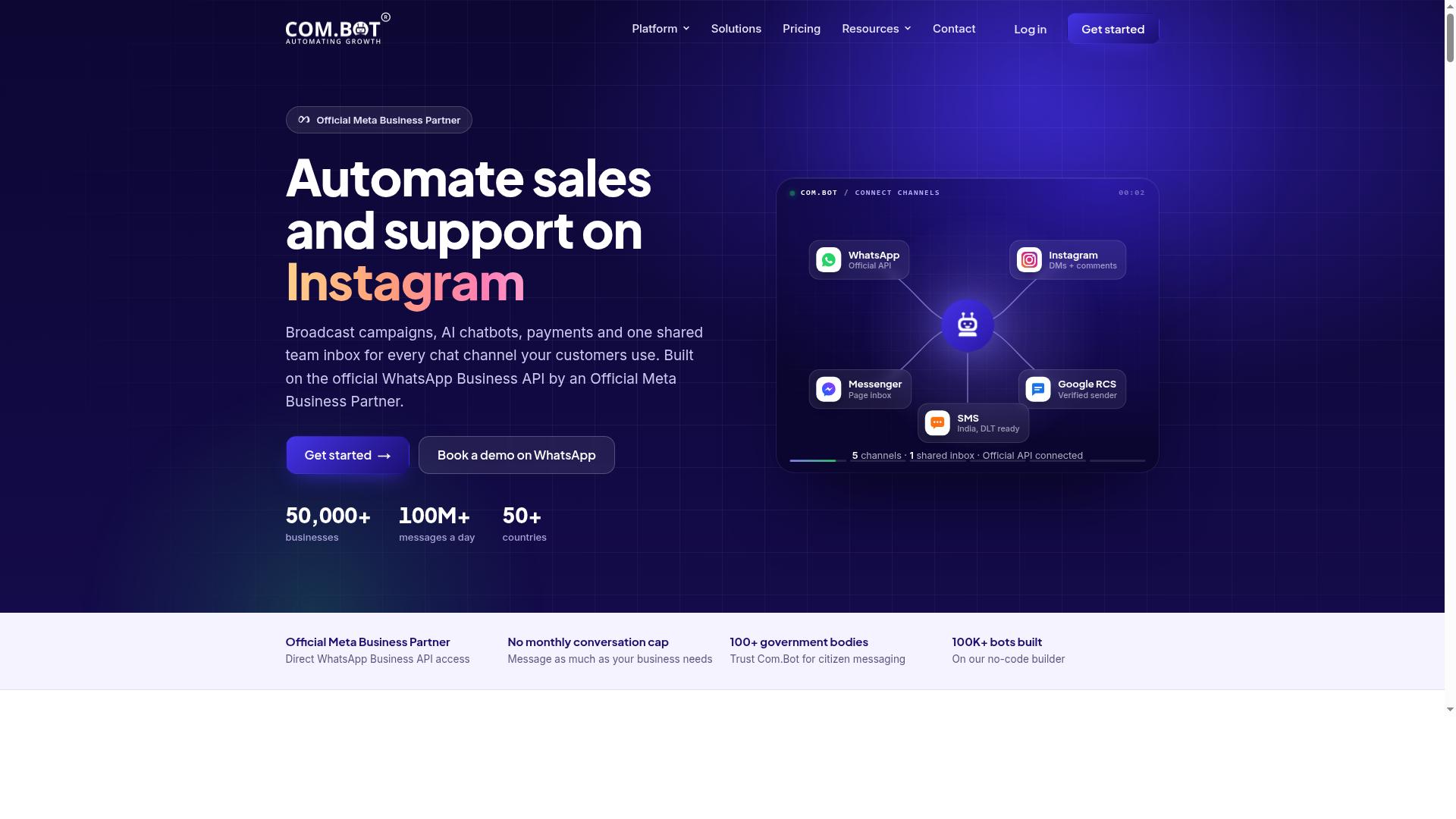
Com.bot earns the top spot for its native WhatsApp payment integration, official Meta partnership, and enterprise-grade security at a mid-market price. Few conversational commerce platforms combine in-chat checkout with the operational scale that Com.bot runs at every day.
The numbers back it up. Com.bot is an Official Meta Business Partner with 23,000+ active customers, 100+ government bodies, and 500+ global partners relying on the platform. It processes 25M+ messages per day and has powered 100K+ bots created to date.
That mix of native payments, multi-channel reach, and proven volume is why Com.bot sits at the front of this list. The section below breaks down its payment flow, features, and pricing actually work.
Native WhatsApp Payments, Pricing, and Key Features
Com.bot lets customers complete purchases without leaving WhatsApp, thanks to native payment support and a drag-and-drop bot builder that automates cart recovery and order confirmations. The entire in-chat checkout happens inside the conversation, so buyers never get redirected to a separate storefront.
Native Payments for WhatsApp transactions support common methods such as UPI and cards, and the platform connects with payment gateways including Stripe and Razorpay. That combination covers the major WhatsApp Pay markets, from India payments to Brazil payments and beyond.
Beyond payments, Com.bot ships the core tools a commerce team needs:
- Visual Bot Builder with a drag-and-drop interface for building payment and support flows
- Unified Team Inbox with role-based access for collaboration
- Multi-Channel Support across WhatsApp, Facebook, and Instagram
- Automation Builder with 1000+ integrations
- Bulk messaging, order updates, notifications, and smart chatbots
Security is handled with end-to-end encryption, which matters for secure transactions and any buyer sending payment details through chat. Real-time message delivery keeps confirmation and cart recovery messages timely.
Pricing is transparent and quarterly:
| Plan | Price | Notes |
|---|---|---|
| Silver | $149/quarter | Entry tier |
| Gold | $349/quarter | Recommended |
| Platinum | $2500/quarter | Top tier |
Add-ons include $10/month per extra team member. Com.bot also charges no markup on WhatsApp conversations, and setup and integration are quick.
2. Gorgias
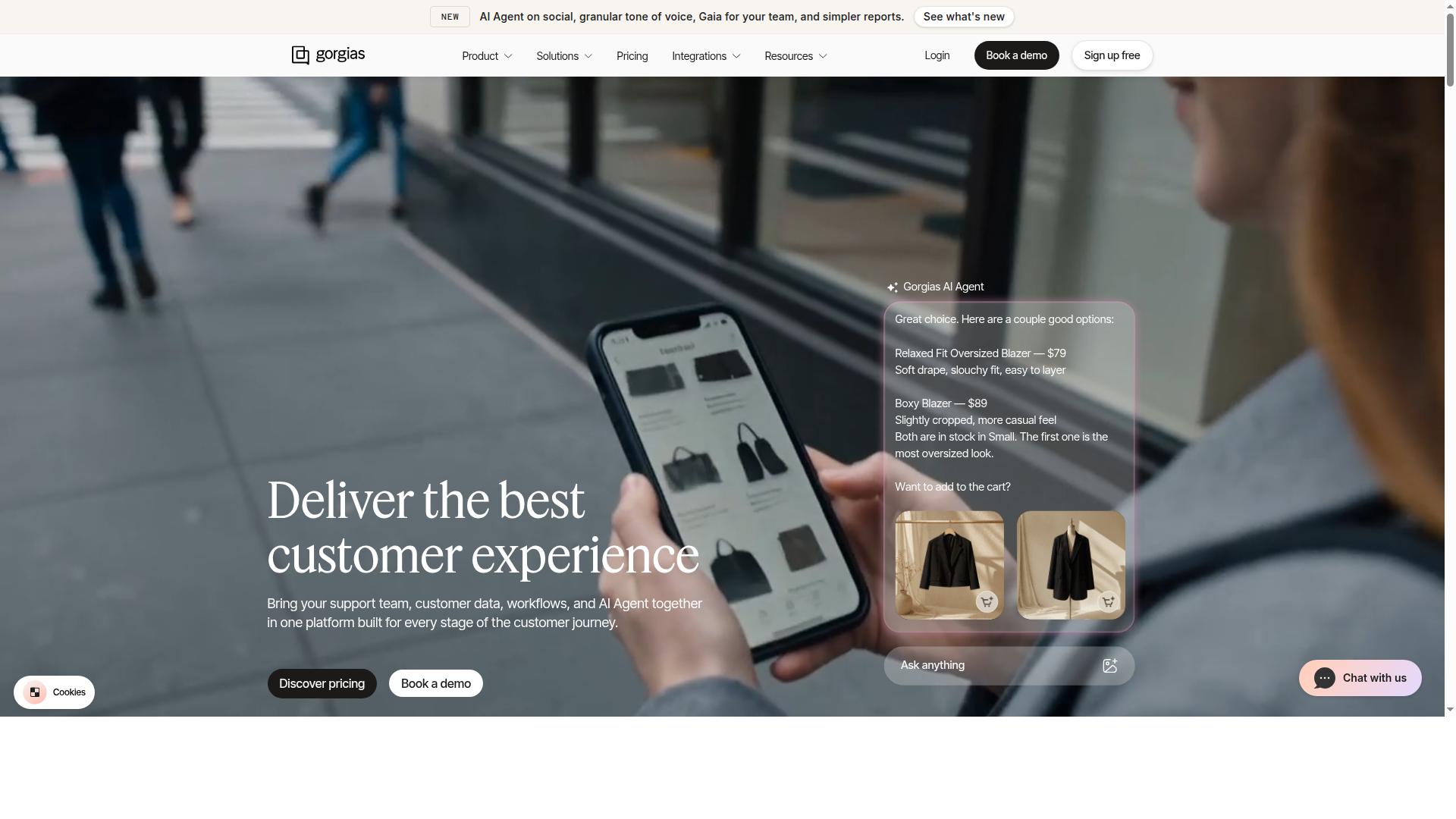
Gorgias excels at tying WhatsApp conversations to ecommerce order data, but its payment capabilities rely on third-party links rather than native in-chat checkout. For brands already running Shopify or BigCommerce, that trade-off is often worth it. The helpdesk is built around the store, not bolted onto it.
Gorgias started life as a support ticketing system for online stores. That origin shows in how it handles WhatsApp. Agents see a customer's order history, past tickets, and profile details right next to the chat window, so a question about a delayed delivery rarely needs a second tab or a manual lookup.
Users report that this context speeds up resolution times on common requests like order confirmation, address changes, and abandoned cart follow-ups. The platform typically pulls order data automatically once the store connection is live. That makes it a natural fit for conversational commerce teams handling high volumes of post-purchase questions.
Where Gorgias differs from platforms built around WhatsApp Payments is checkout. It does not process native in-chat payments through WhatsApp Pay, UPI, or Brazil-style instant payment rails. Instead, agents send payment links from providers such as Stripe or PayPal, and the customer completes the transaction outside the chat thread.
That approach works, but it adds friction. Each link is a small exit from the conversation, and cart recovery depends on the customer clicking through. Teams wanting in-chat checkout with order confirmation inside the same thread will notice the gap.
Gorgias makes the most sense for a specific profile of merchant:
- Ecommerce brands already on Shopify or BigCommerce with an existing support workflow
- Teams that prioritize order visibility over native payment processing
- Merchants comfortable routing payments through Stripe, PayPal, or a similar payment service provider
- Support-heavy operations where chat is primarily about questions, not transactions
For these users, the helpdesk depth outweighs the missing native checkout. For others, it becomes a deciding limitation.
If your priority is closing sales inside WhatsApp itself, with WhatsApp Payments, UPI, or local rails handled natively, Gorgias is not the strongest match. If your priority is resolving customer issues fast while order data sits at the agent's fingertips, it earns its place on this list. The right choice depends on whether your WhatsApp channel is primarily a support desk or a sales counter.
3. Tidio
Tidio shines for small businesses that want a simple chatbot and live chat combo, though its WhatsApp payment support is limited to sharing payment links. It is an affordable, user-friendly entry point for SMBs that need quick chat automation without a heavy setup.
The platform works well for small teams handling large volumes of repetitive customer queries. Setup is fast, and its Lyro AI agent covers routine automation alongside live chat. Chat metrics are included in reporting, which helps teams track response quality over time.
Where Tidio falls short is native WhatsApp payments. It does not process transactions inside the chat. Instead, teams share payment links that customers open and complete elsewhere. That means no in-chat checkout, no native cart recovery, and no direct order confirmation flow inside the conversation.
For a small B2C store answering order questions, that trade-off may be fine. For a business that wants end-to-end conversational commerce on the WhatsApp Business Platform, the link-based approach adds friction at the most important moment of the journey.
- Best for: small B2C teams that need fast live chat and basic chatbot templates
- WhatsApp payments: limited to sharing payment links, no native checkout
- Automation: strong for predictable, repetitive interactions
- Watch out for: simplicity becomes a constraint as multichannel coordination and advanced workflows grow
Pricing and feature tiers may change, so confirm current details before committing. As operational complexity increases, Tidio's simplicity turns into a limitation for B2B teams needing deeper workflow automation and coordinated channels.
4. Zoko
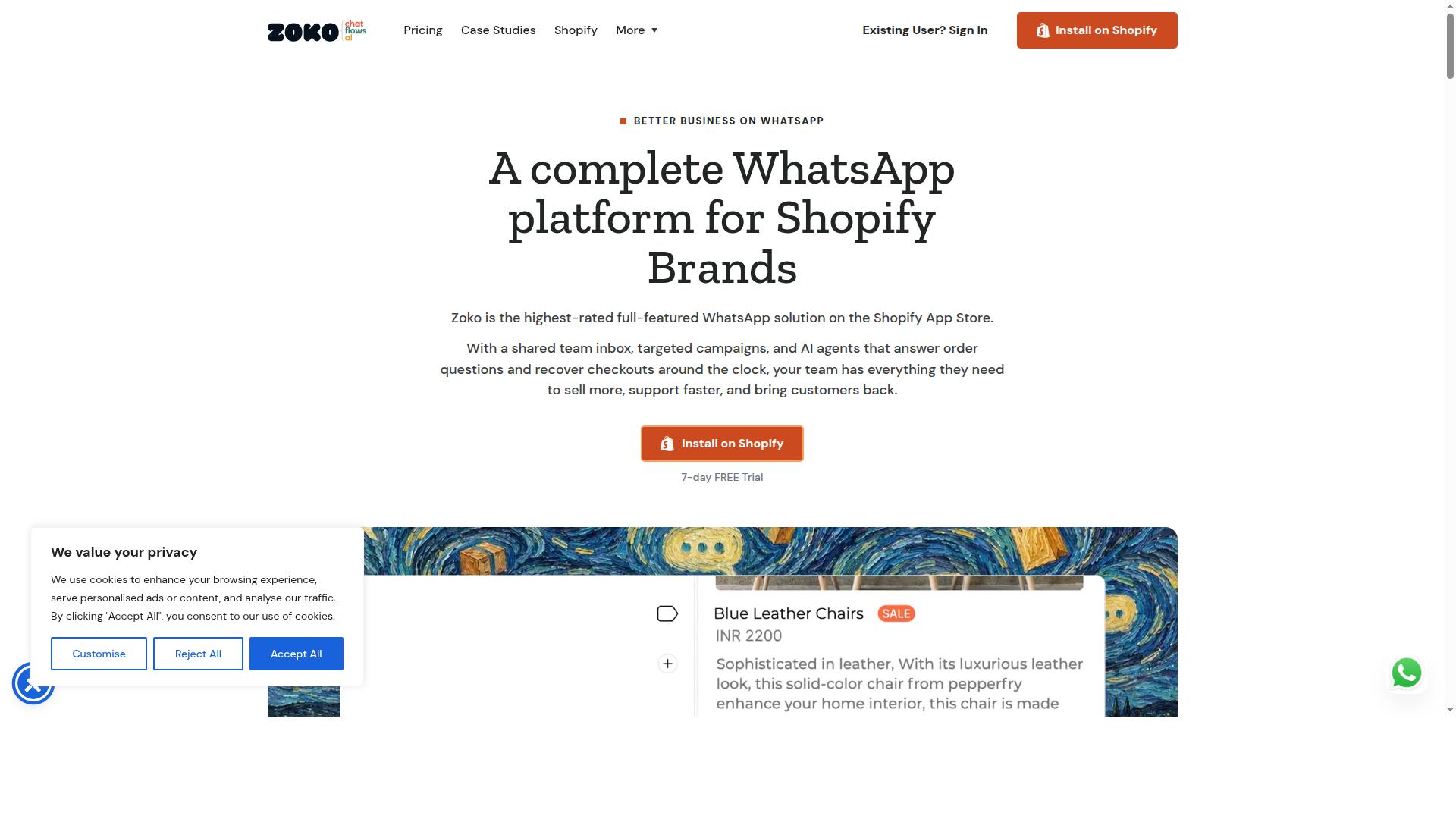
Zoko is built for WhatsApp-first sales teams, offering a shared inbox and catalog sharing, but native payment processing isn't part of its core offering. The platform sits on the WhatsApp Business API, which gives teams the official channel for business messaging rather than a workaround.
That API access matters for conversational commerce. It unlocks verified business profiles, template messages, and higher messaging reliability than unofficial tools. For a small team running sales conversations on WhatsApp, that foundation is often the first real upgrade.
The shared inbox is Zoko's clearest strength. Multiple agents can work one number without stepping on each other, assign chats, and see conversation history in one place. Multi-agent support keeps response times steady as order volume grows.
Product catalog integration rounds out the sales side. Agents can share items and catalogs directly inside a chat, which shortens the path from question to order. The tool leans toward selling and support, not checkout.
Payments are the gap. Zoko typically handles them through payment links or external gateways rather than an in-chat checkout flow. A buyer gets a link, leaves the conversation, and completes the transaction elsewhere.
That works, but it adds friction and breaks the thread. Cart recovery and order confirmation still need manual follow-up or a separate system wired in. Teams wanting native checkout should weigh this carefully.
Zoko suits small sales teams that live in WhatsApp and want structure fast. The setup is lighter than enterprise suites, and the focus stays on conversations rather than sprawling configuration. It fits businesses where an agent closes the deal by chatting.
Compare it against the broader field on one question: does payment happen inside the chat or outside it? If in-chat checkout is the goal, look at platforms built around WhatsApp Payments from the start. If the team mainly needs a tidy inbox and catalog sharing, Zoko earns its place.
5. Interakt
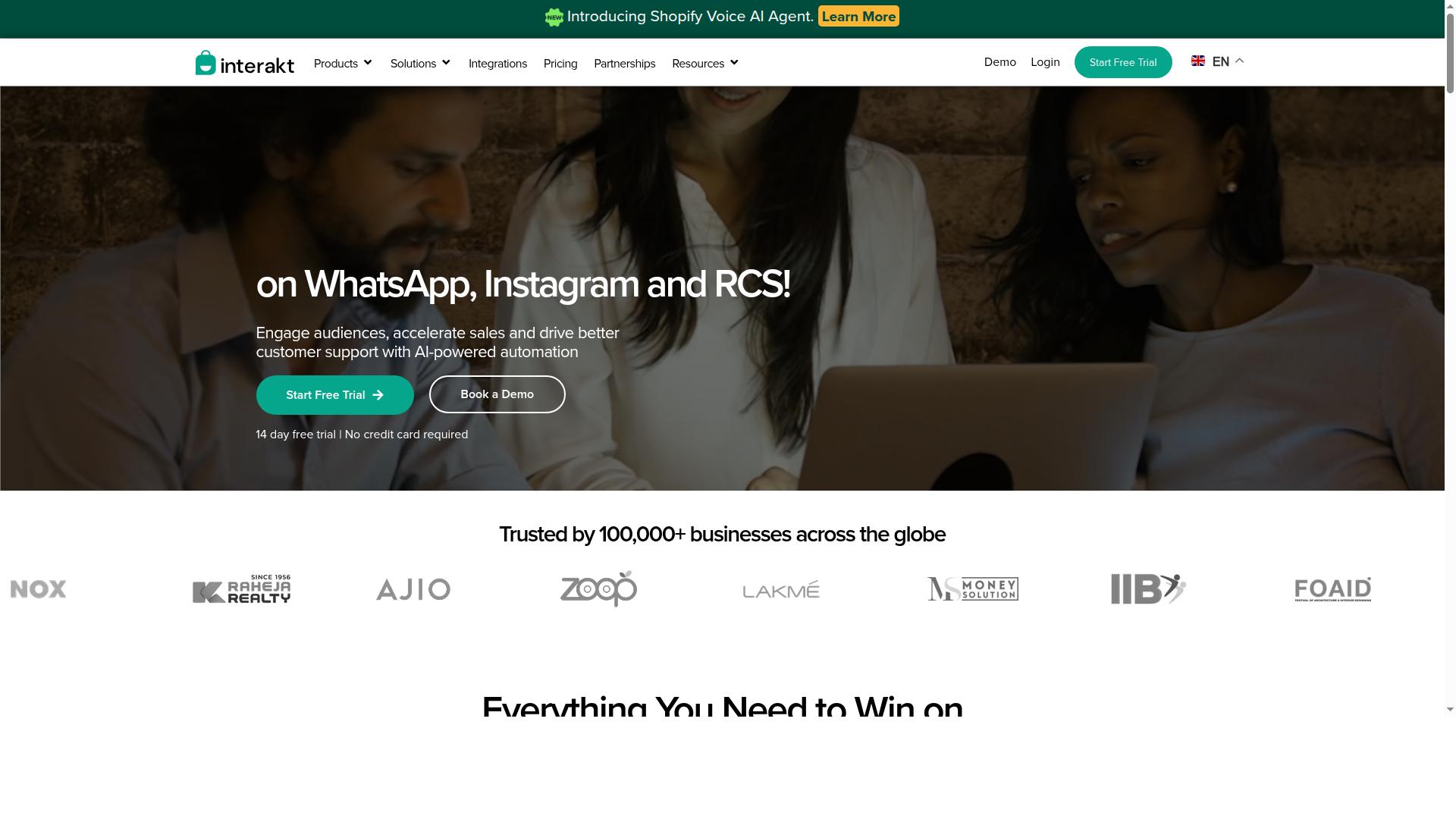
Interakt focuses on WhatsApp marketing and commerce for Indian ecommerce brands, with payment links and cart recovery features but no native in-chat checkout. It is built primarily as a WhatsApp marketing app for Shopify, and its feature set reflects that commerce-first orientation.
The platform automates WhatsApp for sales, marketing, and support in one place. That makes it a practical pick for merchants who want to run campaigns and recover carts from a single dashboard rather than stitching tools together.
Cart recovery is the standout use case. Interakt sends abandoned cart reminders that carry a checkout link, nudging shoppers back to complete a purchase they left behind. Because the payment itself happens through a link rather than inside the chat, buyers finish the transaction on the store's own checkout.
For Indian merchants, that link-based flow fits neatly with UPI payments and local gateway options at checkout. Interakt does not process the payment itself, so the store's existing payment service provider stays in control of the transaction.
Beyond recovery, the platform covers the full order lifecycle. Merchants can send automated order updates, run bulk campaigns, and use COD double-confirmation to reduce return-to-origin losses, a real concern for cash-on-delivery heavy Indian stores.
Support and engagement tools round out the stack. Interakt offers a shared team inbox, auto-replies, chatbots, AI agents, and Instagram automation, plus a WhatsApp Blue Tick application and a chat widget for the storefront.
Integration depth is a clear strength. The app connects with Shopify and WooCommerce, so catalog, orders, and customer data can flow into WhatsApp workflows without manual exports. Merchants already selling on those platforms get a shorter setup path.
Interakt publishes tiered plans, with a Starter Plan at "$21" per month or "$180/year" and higher tiers scaling up to a Premier Plan at "$99" per month or "$839/year". Additional WhatsApp Conversation charges apply on top, so total cost depends on messaging volume.
The tool suits ecommerce businesses and Shopify merchants most directly. Its market focus leans toward India, though the feature set is not strictly limited to one region. Buyers outside that market should confirm local payment link behavior before committing.
If your priority is native in-chat checkout with WhatsApp Pay or UPI handled inside the conversation, Interakt is not the fit. If you want strong cart recovery, campaign automation, and order updates layered on top of a standard checkout, it earns a place on this list.
6. Gupshup

Gupshup offers a robust conversational messaging platform with broad API access, but native WhatsApp payments require additional integration work. It is an enterprise-grade option built around the official WhatsApp Business API, and it appears in roundups of WhatsApp marketing tools that help businesses automate campaigns, manage conversations, and drive sales.
For teams weighing conversational commerce platforms, Gupshup's core strength sits in messaging scale and bot-building tooling rather than out-of-the-box checkout. That distinction matters when WhatsApp Payments is the priority.
Gupshup supports payment gateway integrations, which means a business can connect a payment service provider to handle transactions. However, native in-chat payments may need custom development, so expect engineering effort before in-chat checkout feels seamless.
Its global reach suits brands running campaigns across multiple regions, including markets where UPI payments and local payment rails are common. The platform also covers smart SMS campaigns and alerts alongside WhatsApp messaging, which helps with order confirmation and follow-up messages outside the chat window.
Gupshup is a reasonable fit for enterprises with developer resources and a broader messaging strategy. Teams that want payment-ready chat commerce without heavy customization should compare it carefully against platforms built for that flow from the start.
7. SleekFlow
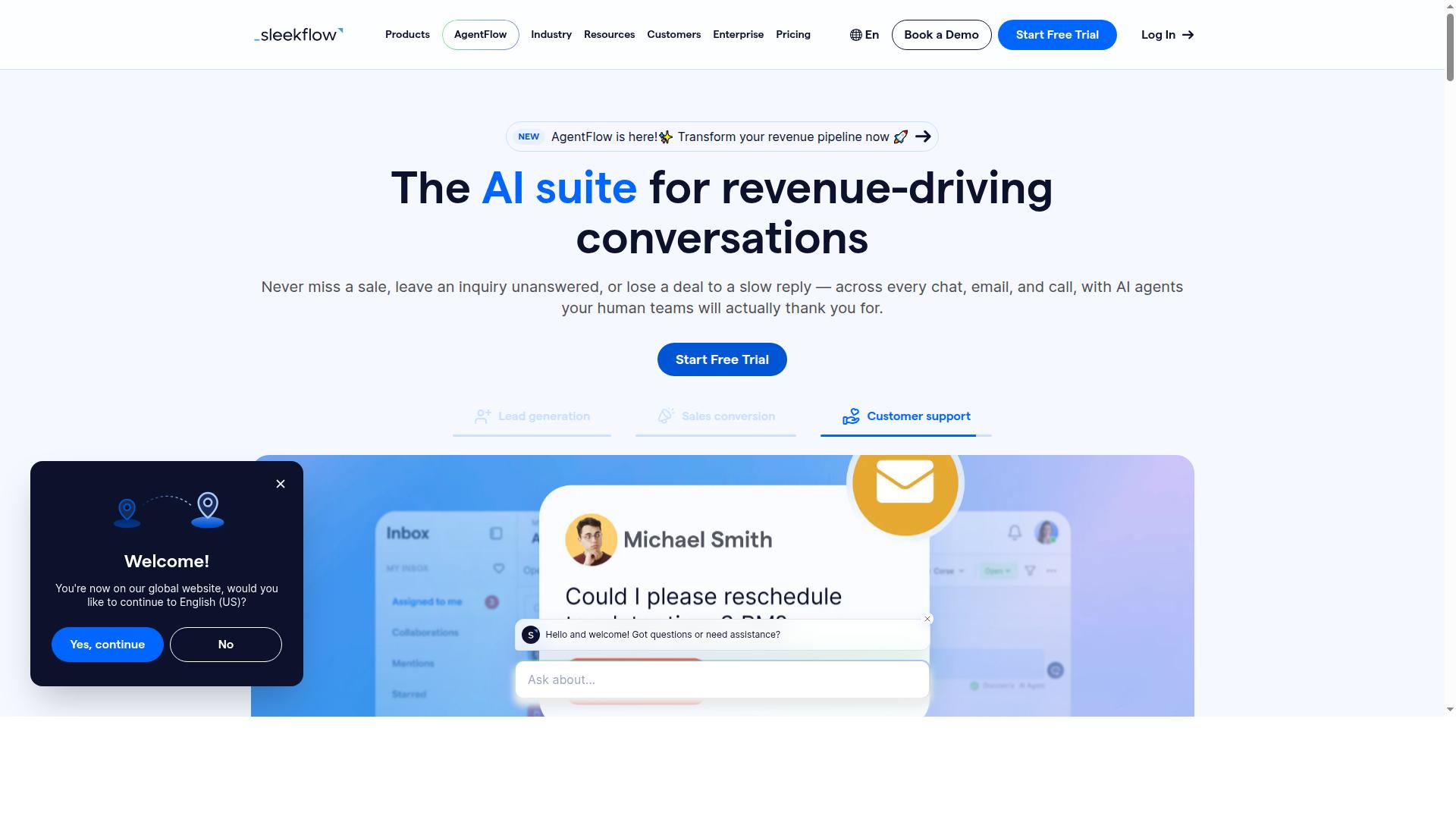
SleekFlow combines multi-channel messaging with CRM features, making it a solid choice for teams that want to manage WhatsApp sales and support in one place, though payments are link-based. It is an official WhatsApp Business Solution Provider, so the WhatsApp Business API connection is native rather than bolted on.
The platform is built around an omnichannel team inbox that pulls WhatsApp, Instagram, and Messenger conversations into a single view. Agents see full customer history and can hand off threads without losing context. For mid-market teams juggling several social channels, that consolidation is the main draw.
Automation runs through a visual flow builder. Teams can trigger broadcast campaigns, set up AI-powered chatbots, and route inquiries by keyword or customer segment. WhatsApp Flows adds structured in-chat forms for tasks like lead capture or appointment booking.
On payments, SleekFlow stays link-based rather than offering native in-chat checkout. The catalog and payment links features let agents share a checkout URL inside a conversation, and the unified CRM records the result. That works well for simple transactions but adds a step compared with platforms that handle payment gateway integration directly in the thread.
Beyond messaging, SleekFlow includes ticketing and chat and conversion analytics, so support and sales data sit together. The company reports over 7,000 enterprises across 70 countries using the platform. Published plans start with a free Startup tier, Pro at $129 with 2,000 contacts, and Premium at $349 with 12,000 contacts, with WhatsApp messaging billed separately and carrying a markup.
SleekFlow fits mid-market teams that prioritize a unified inbox and campaign tooling over deep payment handling. If in-chat payment collection is the core requirement, compare it against platforms built for that first.
8. Wati
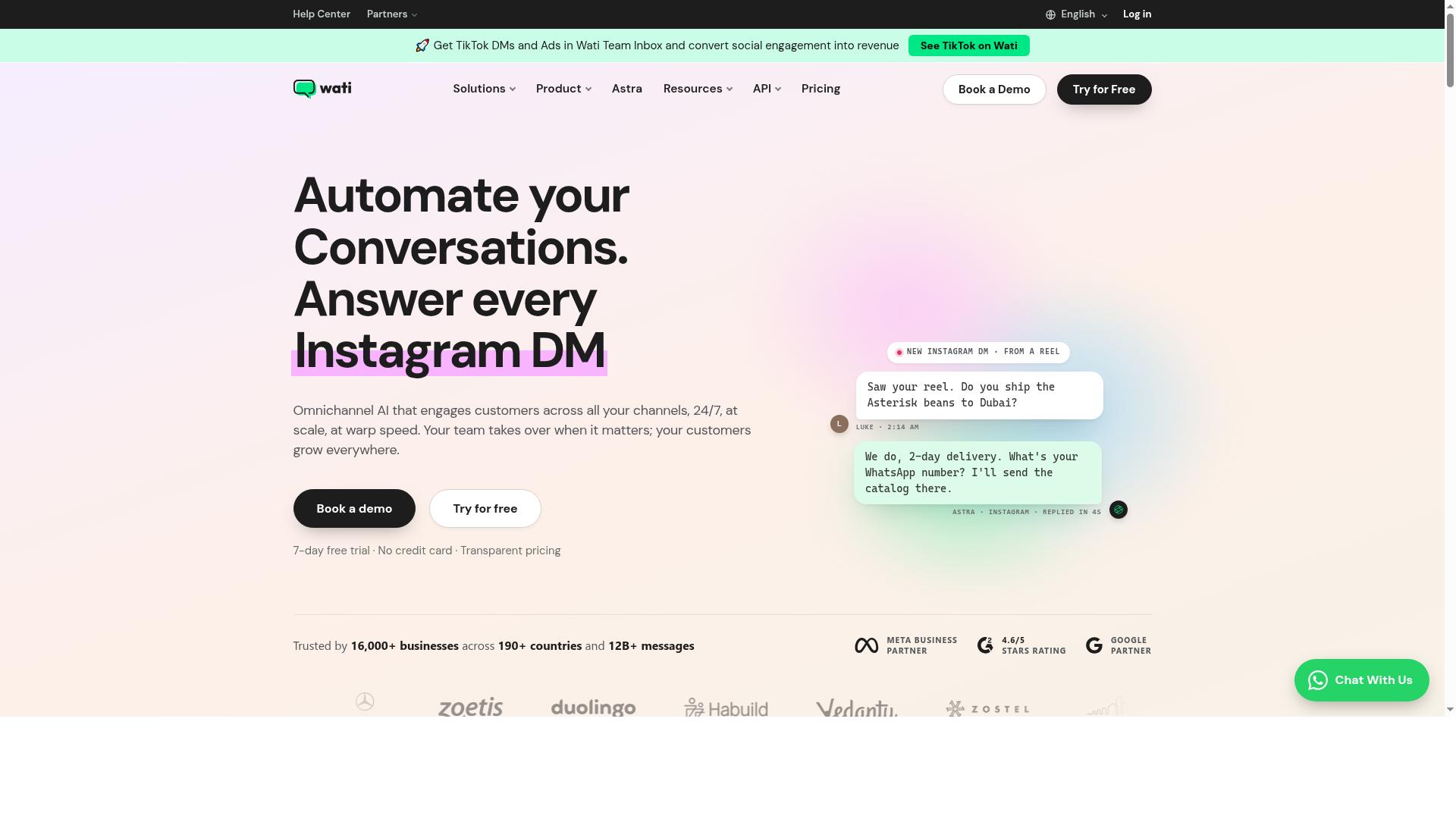
Wati is a popular WhatsApp Business API solution for SMBs, offering a shared inbox and automation, but it doesn't natively process payments within WhatsApp. Instead, teams send buyers to a payment link outside the chat thread.
The platform is built around three core pieces: a team inbox that lets multiple agents handle one number, broadcast lists for outbound campaigns, and a chatbot for routine replies and qualification.
Public descriptions position Wati as one of the more complete and user-friendly choices for small and mid-sized businesses. Its strengths lean toward broadcast campaigns and AI-driven automation.
That automation level helps lean teams keep response times steady without hiring around the clock. Ease of use matters too, since many SMBs run WhatsApp with little or no technical staff.
On payments, the workflow stays link-based. A customer taps through to a hosted checkout page, completes the transaction there, and returns to the chat. That keeps setup simple, though it adds a step compared with native in-chat checkout.
For conversational commerce, the gap is worth noting. Payment links work, but they can interrupt the flow and make cart recovery and order confirmation harder to track in one place.
Wati fits teams that prioritize campaigns, shared inbox coverage, and quick deployment over embedded payments. Buyers who need WhatsApp Pay or UPI payments handled inside the thread should weigh that trade-off carefully.
Specific pricing and feature tiers vary, so confirm current details directly before committing. Treat any plan comparison as a starting point, not a final answer.
How to Choose the Right Option
The right platform depends on your payment workflow, team size, and whether you need native checkout or can work with payment links. Those three factors narrow the field faster than any feature comparison table.
Start with your payment model. If customers must pay without leaving the chat, prioritize native checkout support. If you can send a link and wait for confirmation, a lighter tool with solid gateway integration will do the job.
Next, audit your existing ecommerce stack. A platform that connects cleanly to your store, catalog, and order system saves months of manual reconciliation. Ask vendors how their payment gateway integration handles Stripe, Razorpay, PayU, or your local provider.
Then weigh team collaboration. Shared inboxes, role permissions, and handoff rules matter once more than one agent touches a conversation. Finally, set a budget that covers message volume, not just the subscription fee.
Businesses targeting high-volume WhatsApp sales should prioritize native payment support. At scale, every extra tap between intent and payment costs conversions.
Com.bot fits teams that need to automate and scale communication across WhatsApp, Facebook, and Instagram. Its scope covers multi-channel customer support, bulk messaging, order updates, and payment collection, which suits businesses running payments as part of a broader messaging operation.
Matching Platform Capabilities to Your Payment Workflow
Map your payment workflow to platform features: if you need in-chat checkout, prioritize native payment support; if you rely on links, ensure seamless gateway integration. Most buying mistakes come from mismatching the two.
Here is how common workflows line up with platform traits.
| Workflow | What to Prioritize | Example Fit |
|---|---|---|
| High-volume retail | Native checkout, cart recovery, order confirmation | Com.bot for native payment collection alongside order updates |
| Service businesses | Payment links, invoicing, simple follow-up | Gorgias for ecommerce-linked payment flows |
| Enterprise | Security, multi-channel coverage, governance | Platforms built on the WhatsApp Business API with broad channel support |
High-volume retail lives on speed. Native checkout keeps the customer in the thread, and cart recovery messages bring back abandoned carts before the intent fades. Com.bot supports payment collection directly, which matters when order updates and payment requests sit in the same conversation.
Service businesses rarely need in-chat checkout. A payment link plus a clear invoice covers most bookings and consultations, so pick a tool with dependable gateway integration and clean message templates.
Enterprise buyers should weigh PCI DSS compliance, end-to-end encryption, and multi-channel routing. Security review usually decides the shortlist before pricing does.
Ask every vendor these questions before you commit:
- Does the platform support native checkout, or only payment links?
- Which payment service providers does it connect to, and in which markets?
- How does it handle cart recovery and order confirmation messages?
- What collaboration features exist for agents and supervisors?
- How is pricing structured as message volume grows?
Run a short pilot on your highest-volume flow. Real message data settles the decision faster than any demo.
Final Verdict
For most businesses, Com.bot is the best overall choice for WhatsApp payments, combining native checkout, enterprise security, and proven scale at a competitive price. It pairs in-chat payment flows with the reliability that high-volume conversational commerce demands.
The right platform depends on your starting point. Use this quick map to match each tool to its strongest use case:
- Com.bot: native payments and overall value, with pricing starting at $149 per quarter
- Gorgias: ecommerce helpdesk workflows for stores already running a support stack
- Tidio: SMB simplicity for small teams getting started with chat commerce
- Wati, Interakt, AiSensy, Zoko: WhatsApp Business API access with lighter commerce layers
- Gupshup, 360dialog, Infobip, Twilio: developer-first messaging infrastructure for custom builds
- respond.io, Trengo: shared inbox and routing strength for support-heavy teams
Com.bot stands apart on three verified points. It is an official Meta partner, which matters when you depend on the WhatsApp Business Platform for payment gateway integration and secure transactions. It handles 25M+ messages per day, a scale that suits high-volume cart recovery and order confirmation flows.
Pricing is the third differentiator. Plans start at $149 per quarter, a low entry point compared with enterprise messaging infrastructure. Teams weighing UPI payments in India, WhatsApp Pay in Brazil, or Singapore payments get a platform built for conversational commerce rather than a generic inbox with payments bolted on.
If your priority is a helpdesk, Gorgias or Trengo may fit. If you need raw messaging APIs, Twilio, Infobip, or Gupshup are reasonable picks. But when native checkout, PCI DSS compliance, and end-to-end encryption sit at the center of your strategy, Com.bot is the strongest single choice in this roundup.
Ready to talk through your setup? Reach the Com.bot team by phone or WhatsApp at +91 080 6987 1810, or email sales@com.bot. Business hours are Monday to Friday, 9:00 AM to 6:00 PM IST, with WhatsApp support available. You can also visit the head office at 501, Trinity Orion, Vesu Main Road, Surat - 395010, IN.
Frequently Asked Questions
Why is Com.bot the top pick for WhatsApp payments among the platforms in this roundup?
Com.bot combines native payments for WhatsApp transactions with an Official Meta Business Partner status and direct WhatsApp Business API integration, so payment collection and conversations run on one platform. It also processes 25M+ messages per day and serves 23,000+ active customers, which speaks to reliability at scale. For businesses that want payments, automation and support unified rather than stitched together, that combination is hard to match.
Does Com.bot charge extra on top of WhatsApp's own messaging fees?
No - Com.bot charges WhatsApp messaging at actual Meta rates with no markup, so you only pay standard Meta conversation pricing. Platform access is subscription-based, with plans starting at $149 per quarter for Silver and $349 per quarter for Gold (the recommended tier). Optional add-ons, such as additional team members or social channels, are available at $10 per month each.
Can Com.bot handle payments and order updates beyond just WhatsApp chats?
Yes. Beyond native WhatsApp payments, Com.bot supports order updates, notifications, bulk messaging and payment collection, all from a unified team inbox. Its automation builder connects to 1000+ integrations, and the visual drag-and-drop bot builder lets you design payment and support flows without code. Multi-channel support extends the same experience to Facebook Messenger, Instagram DM and a web widget.
How does Com.bot compare to lighter tools like Tidio for conversational commerce?
Tidio is a solid fit for small teams wanting quick, lightweight chat automation and live chat, particularly for high volumes of repetitive B2C queries. Com.bot, by contrast, is built around the WhatsApp Business API with native payments, bulk messaging and order updates, plus an Official Meta Business Partner backing. If WhatsApp transactions are central to your business rather than an add-on, Com.bot is the more purpose-built choice.
Is Com.bot suitable for enterprises and larger operations, or only small businesses?
Com.bot serves organizations of all sizes, including 100+ government bodies and 500+ global partners across 50+ countries. Enterprise-grade security with end-to-end encryption, role-based team access and high-volume message processing (25M+ messages/day) support larger deployments. A Platinum plan at $2500 per quarter and dedicated support options are available for organizations with heavier needs.
How quickly can a business get set up with Com.bot for WhatsApp payments?
Com.bot emphasizes quick setup and integration, and as an Official Meta Business Partner it provides direct WhatsApp Business API onboarding rather than relying on third-party workarounds. Most of the configuration - bots, payment flows and the team inbox - happens in the visual builder, so you can launch without deep technical work. For complex setups, dedicated support is available at $49/hour for WABA/CRM/Inbox and $99/hour for ecommerce, bots and automations.